Guardianship and Inheritance — Promotion of Traditional Culture Protection

资料提供方:Yichen Zhiguang (Beijing) Technology Co., Ltd.
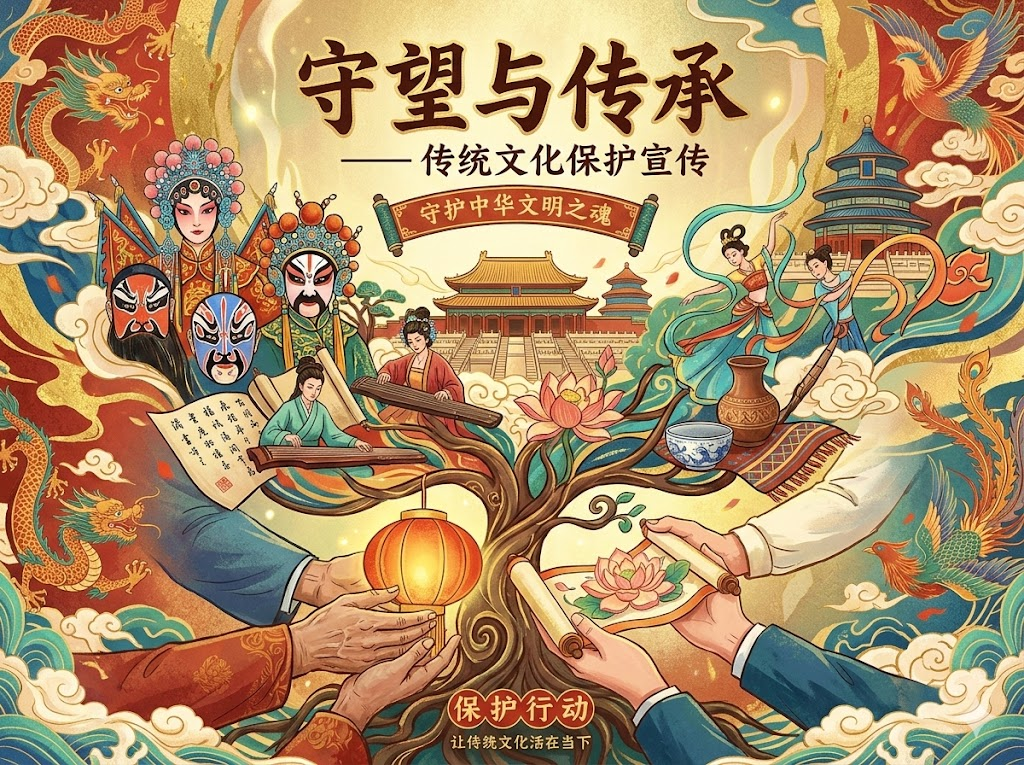
Project "Guarding and Inheriting — Promotion of Traditional Culture Protection" is based on practical data from the "Cultural Intelligence・Digital Civilization Lab". It develops a general-purpose multimodal AI collaborative system to address three core pain points of traditional culture: difficulty in digital preservation, complexity of refined restoration, and limitations in daily-life communication, contributing to the protection of global cultural diversity and the sustainable development of cultural communities.
Closely aligned with the purpose of the Boao Global Youth AI Application Challenge, the project provides a general AI framework that is operable for teenagers and technically implementable. It solves core problems through three modules, adapting to the capabilities of participants from different academic stages. Led by teenagers and integrating interdisciplinary knowledge, the project achieves measurable and implementable practical outcomes through phased implementation of data collection, model development, and on-site verification. It not only fills the gap in AI applications led by teenagers in the field of cultural protection but also serves cultural inheritance bases in the long term, supports community revitalization, and has both competition value and social significance.

解决方案
Guarding and Inheriting — Promotion of Traditional Culture Protection
Solution
I. Project Theme
Based on practical data from the "Cultural Intelligence · Digital Civilization Lab", this project develops a general-purpose, multimodal AI collaborative system to address three core common problems faced by traditional culture (including but not limited to craftsmanship, performing arts, and oral traditions): difficulty in digital preservation, complexity of refined restoration, and limitations in daily-life communication. It contributes to the protection of global cultural diversity (SDGs 11.4) and the sustainable development of cultural communities (SDGs 8.9).
II. Project Background and Problem Statement
1. Common Industry Pain Points (Based on Extensive Cultural Research)
Physical Loss and Generational Discontinuity: Both tangible cultural heritage (cultural relics, ancient architecture) and intangible cultural heritage (craftsmanship, performing arts, oral legends) rely heavily on interpersonal inheritance or physical media. Once inheritors pass away or physical media are damaged, the core cultural essence faces irreversible loss.
Bottlenecks in Scientific Restoration and Reconstruction: The restoration of incomplete cultural relics, blurry images, damaged documents, and lost music scores is often time-consuming and highly subjective. Traditional methods struggle to accurately restore their true charm or scientific structure.
Conflict Between Community Development and Cultural Protection: Traditional cultural communities (such as intangible cultural heritage villages and ancient towns) lack the ability to transform traditional elements into modern (Guochao) products. Difficulties in cultural commercialization lead to low willingness of young people to engage in related industries, resulting in an imbalance between community development and cultural protection.
2. Project Value
Closely aligned with the core purpose of the Boao Global Youth AI Application Challenge — "AI for Good · Solving Real Social Problems", this project provides a general AI framework that is operable for teenagers and technically implementable. Participants can select any type of traditional culture as the application object according to their own interests to carry out technical implementation, filling the gap in AI applications led by teenagers in the field of generalized cultural protection.
III. General AI Technical Solution Framework (Modular Design, Adapted to Youth Technical Capabilities)
1. Core Technical Architecture
It adopts the architecture of "Multimodal Holographic Digital Evidence + Intelligent Restoration and Enhancement (Generative AI) + Ecological Symbiosis Recommendation", balancing technical innovation and operability for teenagers (based on the foundation of 3D generation, diffusion models, time series models, etc. in the laboratory).
2. Design of Three General AI Functional Modules
Module 1: Holographic Cultural Data Asset Construction Module (Solving "Difficulty in Preservation") It is a general framework for data collection and reconstruction.
For tangible culture (cultural relics, ancient architecture): Use NeRF (Neural Radiance Fields) or 3D scanning technology to train models to convert 2D images into high-precision 3D digital assets.
For intangible culture (performing arts, craftsmanship): Use AI motion capture (MoCap) or multi-view video analysis to convert the movements and singing voices of senior artists into digital motion sequences and audio data.
Examples of free application scenarios for participants: 3D reconstruction of ancient buildings, digitalization of Peking Opera singing and movements, restoration of ancient loom structures, and collection of local dialect voices.
Module 2: Intelligent Cultural Core Restoration and Enhancement Module (Solving "Complexity of Restoration") It is a general framework for restoration and enhancement generation.
For images/3D models: Use Inpainting and geometric completion technology to train models to complement incomplete and peeling cultural object data.
For audio/video: Use audio enhancement technology (denoising, sound source separation) and video super-resolution technology to restore blurry performance recordings and lost ancient music scores.
Examples of free application scenarios for participants: Virtual restoration of damaged murals, intelligent completion of lost guqin scores, enhancement of local opera videos from decades ago, and restoration of ancient book fragments.
Module 3: Community-Protection Collaborative Ecological Innovation Recommendation Module (Solving "Limitations in Communication") It is a general framework for cultural and creative generation and community development recommendation.
Using Generative AI (such as diffusion models or language models), combined with community survey data, it integrates traditional cultural elements (patterns, tones, stories) with modern aesthetics (Guochao) to automatically generate cultural and creative design drawings, digital record packaging, and immersive plot scripts.
Examples of free application scenarios for participants: AI-generated trendy shoes with Dunhuang patterns, AI-generated script murder games combined with dialect stories, and AI analysis of tourist flow to optimize homestay layouts in ancient villages.
IV. General Project Implementation Process (Phased Implementation)
1. Data Collection Phase (Extensive Scientific Expeditions and Community Surveys)
Basic data: Collect physical data (photos, videos, audio), historical documents, interviews with senior artists, and community development needs (questionnaires) of the selected traditional culture through the "Cultural Conservation Cabin".
2. Model Development Phase (Intensive Tackling + After-Class Optimization)
Junior High School Group: Based on open-source frameworks (such as NeRF tools and simple motion capture AI), realize the primary digital preservation and interactive application Demo of the selected culture.
Senior High School Group: Independently fine-tune Generative AI (restoration, generation) models to solve specific cultural incompleteness or innovative generation problems, and develop Web/AR visualization display platforms.
3. Verification and Iteration Phase (Linking Inheritance Bases and Communities)
On-site Verification: Feed back the AI-generated restoration data, design schemes, and communication tools to experts, inheritors, and local relevant institutions, compare expert opinions, and iterate the models.
Community Pilot: Pilot "AI-generated innovative products/communication schemes" in relevant cultural villages or workshops, and track trial production feedback and communication effects.
V. Project Outcomes and Social Impact (General Indicators)
1. Quantitative Outcomes (Core Competition Display Indicators)
Types of Outcomes, Specific Common Indicators, General Competition Display Forms
Technical Outcomes:
1). Digital reconstruction accuracy/restoration degree score (comparison with experts/standard databases);
2). Virtual restoration consistency score (expert review);
3). Improvement in innovative generation efficiency.
2. Dashboard for comparison before and after restoration/generation (3D models/audio and video/design drawings).
Practical Outcomes:
1). Form the "Practice Report on AI-Enabled Traditional Culture Protection" (English version);
2). Obtain "Technical Practice Certification" from relevant cultural institutions/workshops;
3). 2 AI solutions are adopted by communities and put into trial use.
Display Forms:
1). Report display board (including recommendation letters from experts/inheritors);
2). 3D printed models/AI-designed physical objects/AI-enhanced videos.
3. Social Impact (Meeting the "Global Perspective" Requirement of the Challenge)
Cultural Level: Provide a "general paradigm for youth AI practice" for the protection of various types of traditional cultures around the world.
Educational Level: Link with the "Global Action Cabin" to translate project cases into multiple languages.
Policy Level: Strive to include the project outcomes into the relevant youth cultural diversity protection case databases of UNESCO or APEC.
VI. General Design for Competition Presentation and Defense
1. Presentation Form (Meeting the "Visualization + Interaction" Requirements of the Boao Challenge)
Main Vision: Combine personalized cultural IP to design a general display board (Left: Problems and technical framework; Right: Implementation process and outcomes; Middle: Suspended virtual cultural assets reconstructed by NeRF).
Interactive Session: Set up an "AI Restoration Master" or "AI Innovation Lab" experience area, where judges can hand-draw "damaged" digital models or input innovative needs on site to view AI restoration/generation results in real time.
2. Core Defense Logic (Highlighting Youth Perspective and Innovation Points)
Problem Focus: Briefly describe the on-site experience of the "risk of loss of the selected culture" (combined with specific scientific expedition experience).
Technological Innovation: Emphasize "operability for teenagers" — instead of complex models with huge computing capacity, use popular open-source tools to solve specific problems.
Global Value: Link with the concept of "global collaboration" and explain how the project contributes to the protection of humanity's common heritage.
VII. Project Highlights (Differentiated Competitiveness)
1. Interdisciplinary Integration and Versatility Break through the limitations of a single AI technology competition, integrating "cultural decoding + artistic aesthetics + economic revitalization" — for example, introducing ancient book theories into restoration models to make digital culture live in the current space. Participants can freely combine the characteristics of the selected culture.
2. Youth-Led From data collection to model development, all work is completed by students, reflecting that "teenagers are the core force of cultural inheritance and technological innovation".
3. Long-Term Impact and Versatility The project is not limited to the competition; it will continue to serve the inheritance bases of the selected culture, help community revitalization, and promote the integration of AI protection schemes into the global youth ecological initiative.

Package